

Anti Vibration Mountings
Home » Anti Vibration Mountings
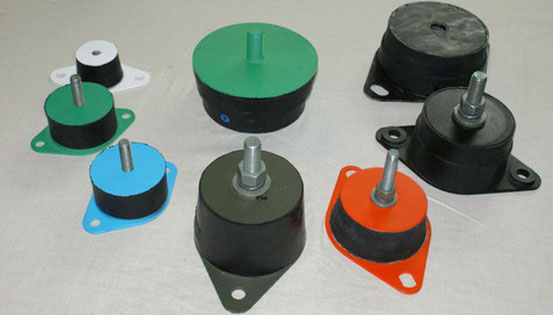
Rubber anti-vibration mountings are used in a vast range of applications where the prime objective is to eliminate harmful vibration and reduce noise and absorb shock. The high internal isolating properties of rubber make them well suited for making anti-vibration mountings. A wide range of rubber anti-vibration mountings is available.
Types of Rubber used
- Natural Rubber
- Neoprene
- Silicone
- SBR
- EPDM
Functions of Anti Vibration Mountings
- Isolate vibrations from work surfaces
- Reduce noise levels
- Absorb shock
Properties of Rubber Anti Vibration Mountings
- Withstand the extreme operating environments.
- Resistance to oils.
- Resistant to surface abrasion wear and sunlight exposure.
- Withstand large temperature fluctuations.
- Radial elasticity greater than axial elasticity.
- The rubber can work in:
- Compression
- Shear
- A Combination shear/compression
- A wide variety of dimensions is available.
- Easy to Fix.
Types of Anti Vibration Mounts
- Cylindrical Mounts: Mountings usually for general
low cost applications. They are easy-to-install mounts, made of high
quality rubber and provided with mild steel connection plates.
- Technical Mounts: Rubber mounts providing a
technical solution for reducing noise and vibration transmission and
shock protection.
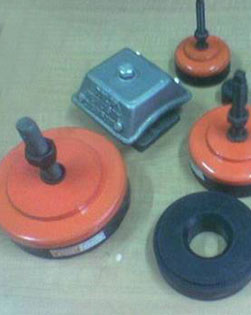
- Leveling Mounts:The elastomer base has anti-slip
ridges.
- Anti Vibration Plates: Plates, providing a good protection and decreasing the noise level in workshops.
Rubber mountings provide vibration isolation solution to the following:
- Cooling systems
- Chassis to body excitation
- Sensitive electrical /
electronics equipment - Cab mounting
- Suspension systems
- Engines
- Transmissions / gearboxes
- Fuel systems / fuel tanks
- Steering linkages
- Exhaust systems
- Torque / drive couplings
- Pipework
- Electrical enclosures
Industrial Applications
General IndustryRubber anti-vibration mountings are used for a variety of industrial application like as in compressors, pumps, generator sets, electronic components, agricultural machinery, and earth moving construction machinery.
Marine Industry
A wide range of rubber anti-vibration mountings are used for the support of marine propulsion engines, chiller-units, generator sets, cooling machinery, compressors and pumps. Exhaust Anti-vibration Mountings in combination with expansion joints are used for the flexible support and assembly of exhaust systems on board ships.
Automotive and Railway Industry
Couplings, rubber to metal-bonded suspension components, anti vibration mountings are available for use in the automotive and railway industry.
Product Catalog
Industrial Applications
Industrial Rubber Products
Types of Synthetic Rubber
General Information
- Anti Vibration Mountings
- Automobile Rubber Products
- Calendered Rubber Products
- Extruded Rubber Products
- Medical Rubber Products
- Metal Bonded Components
- Rubber Adhesives & Sealants
- Rubber Ball
- Rubber Bands
- Rubber Beading
- Rubber Bearing
- Rubber Belt
- Rubber Buckets
- Rubber Bullets
- Rubber Cable
- Rubber Coating
- Rubber Duct
- Rubber Expansion Joints
- Rubber Flooring/Matting
- Rubber Footwear
- Rubber Gloves
- Rubber Injection Parts
- Rubber Lining
- Rubber Magnets
- Rubber Molded Products
- Rubber Pads
- Rubber Rollers
- Rubber Stopper
- Rubber Suit
- Rubber Track
- Rubber Valve
- Rubber Balloon
- Rubber Stamps
- Rubber Fenders
- Acrylic Rubber (ACM)
- Butadiene Rubber (BR)
- Butyl Rubber (IIR)
- Chlorosulfonated Polyethylene(CSM)/ Hypalon
- Ethylene Propylene Diene Monomer
- Fluoroelastomers (FKM)/Viton
- Isoprene Rubber (IR)
- Nitrile Rubber (NBR)
- Perfluoroelastomer (FFKM)
- Polychloroprene (CR)/Neoprene
- Polysulfide Rubber (PSR)
- Silicone Rubber (SiR)
- Styrene Butadiene Rubber
Featured Articles
How to Make a Custom Rubber Stamp?
Whenever designing a custom stamp for your company, never compromise on its quality because in the end it is the most...
Read MoreLatex and Silicone Rubber Tubing - A Comparison!
Many industries use rubber tubing for various purposes. In fact, various types of rubber tubing are used for different applications...
Read MoreSilicone vs Acrylic Adhesive- A Comparison
Silicon and acrylic adhesives are those rubber adhesives that are widely used in Polyimide tapes. In fact, the polyimide...
Read More
Copyright 2022 Industrial Rubber Goods All rights reserved.