

Rubber Stripes and Profiles
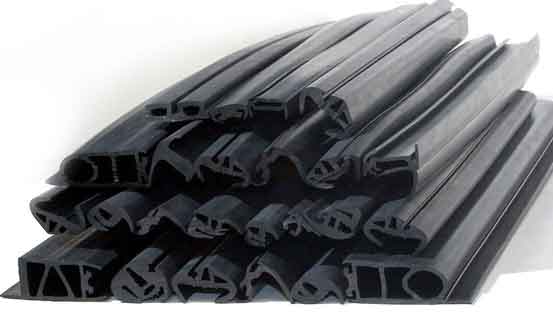
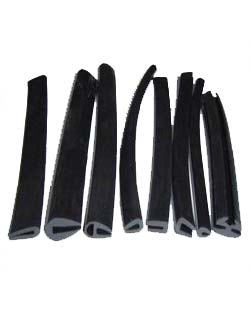
The rubber stripes and profile are considered to be the most popular product in rubber extruding production line. Rubber stripes and profiles are used in many fabricators of rubber products across the country. The types of profiles and stripes are available in a variety of shapes, sizes, rubber materials and splicing methods.
Types of rubber used in making profiles and stripes- Neoprene
- Fluoroelastomers (FKM)/Viton
- Silicone Rubber (SiR)
- Natural Rubber
- Nitrile Rubber
- Styrene Butadiene Rubber
- Ethylene Propylene Diene Monomer (EPM, EPDM)
- Solid rubber profiles
- Sponge rubber profiles
- Co-extruded profiles
- Flocked profiles
- Profiles with metal inserts
Compared with the traditional wooden, steel and aluminum profiles, rubber profiles have the following strong points:
- Good endurance
- Fine air proof. This means that it can save 10% of energy.
- It can effectively reduce the noise outside compared to the traditional ones.
- Rubber profiles are easy to process, and can save time and labor.
- There rubber profiles are beautiful and endurable and are ideal product for replacing the traditional profiles.
- Some profiles are push-and-pull type.
- High elasticity material.
- It is convenient to store and easy to install.
- This product is good looking.
- Available in various colors.
- High precision & low tolerance.
- Good shape finishing
Uses of rubber stripes and profiles
Extruded rubber profiles can be cut and coil or spooled according to
specified lengths. There are high-speed cut-to-length and coiling machinery
to do this. Pressure sensitive adhesive (PSA) can be applied to extruded
rubber profiles. Extruded rubber profiles can be to used to produce custom
rubber gaskets and o-rings according to specifications. Profiles are used
serve as sealing components with anti friction qualities for the smooth
operation of windows and doors. These rubber profiles are extensively used
in a vast range of diverse applications including automotive
air-conditioning. There are rubber profiles that serve as sealing components
used between the glass and aluminium sections that from the core of the
modern building indust ry.
- Anti Vibration Mountings
- Automobile Rubber Products
- Calendered Rubber Products
- Extruded Rubber Products
- Medical Rubber Products
- Metal Bonded Components
- Rubber Adhesives & Sealants
- Rubber Ball
- Rubber Bands
- Rubber Beading
- Rubber Bearing
- Rubber Belt
- Rubber Buckets
- Rubber Bullets
- Rubber Cable
- Rubber Coating
- Rubber Duct
- Rubber Expansion Joints
- Rubber Flooring/Matting
- Rubber Footwear
- Rubber Gloves
- Rubber Injection Parts
- Rubber Lining
- Rubber Magnets
- Rubber Molded Products
- Rubber Pads
- Rubber Rollers
- Rubber Stopper
- Rubber Suit
- Rubber Track
- Rubber Valve
- Rubber Balloon
- Rubber Stamps
- Rubber Fenders
- Acrylic Rubber (ACM)
- Butadiene Rubber (BR)
- Butyl Rubber (IIR)
- Chlorosulfonated Polyethylene(CSM)/ Hypalon
- Ethylene Propylene Diene Monomer
- Fluoroelastomers (FKM)/Viton
- Isoprene Rubber (IR)
- Nitrile Rubber (NBR)
- Perfluoroelastomer (FFKM)
- Polychloroprene (CR)/Neoprene
- Polysulfide Rubber (PSR)
- Silicone Rubber (SiR)
- Styrene Butadiene Rubber
How to Make a Custom Rubber Stamp?
Whenever designing a custom stamp for your company, never compromise on its quality because in the end it is the most...
Read MoreLatex and Silicone Rubber Tubing - A Comparison!
Many industries use rubber tubing for various purposes. In fact, various types of rubber tubing are used for different applications...
Read MoreSilicone vs Acrylic Adhesive- A Comparison
Silicon and acrylic adhesives are those rubber adhesives that are widely used in Polyimide tapes. In fact, the polyimide...
Read More