

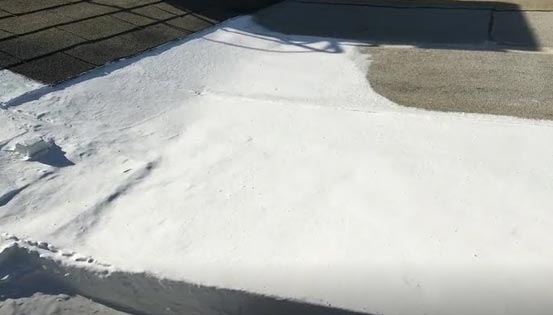
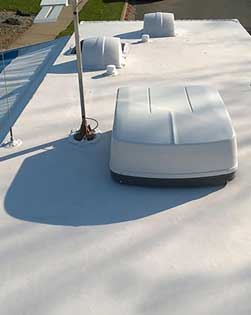
25 October 2010- Liquid rubber is described as EPDM rubber in liquid form which has been used in the rubber industry for varied applications for quite a long period of time. This type of rubber is popular as it has a resistance for the extremes of temperature and has an elasticity of 300%. The temperature range that it can resist is from -60 to 300 degrees. Liquid rubber is Ozone and UV resistant, has high flexibility and crack-bridging ability, can be used on areas exposed to constant sunlight. Because this rubber is capable of forming a waterproof and seamless coating immediately when applied, it is widely used in roof repairing and roof coating. It has proved very helpful in sealing roof leaks. The liquid rubber when applied properly on roof coating can create a seamless membrane. It is a very protective coating
Liquid Rubber Coating
Difference Between Liquid EPDM and Other Types of Rubber
- Similar to sheet EPDM but in a liquid form.
- Easy to apply.
- Can be applied virtually on all surfaces.
- Thicker than the standard elastomers.
- Effective even in single coat application.
- Creates a seamless membrane.
- Resistant to wide temperature fluctuations.
Why Liquid Rubber is Suitable for Roof Coating ?
- Easy to apply.
- Repairing or Coating is done in a single coat system
- Coating done instantly and so less project time.
- Water based rubber. There is no mixture of harmful vapor.
- Extremely flexible.
- Odorless
- There are no laps or joints in roof coating.
- High resistance to puncture.
- Allows flexibility of architectural design
Applications of Liquid Rubber
Liquid Rubber is widely used in solving the recurring problems produced by roof leaks. It can be applied on roof, roof decks, gutters, metal roofs, air conditioner enclosures, cooling towers, structural steel, galvanized steel, chimneys, non porous masonry surfaces, fiberglass, wood, cement, canvas, vinyl, PVC and polycarbonate plastic etc.
- Anti Vibration Mountings
- Automobile Rubber Products
- Calendered Rubber Products
- Extruded Rubber Products
- Medical Rubber Products
- Metal Bonded Components
- Rubber Adhesives & Sealants
- Rubber Ball
- Rubber Bands
- Rubber Beading
- Rubber Bearing
- Rubber Belt
- Rubber Buckets
- Rubber Bullets
- Rubber Cable
- Rubber Coating
- Rubber Duct
- Rubber Expansion Joints
- Rubber Flooring/Matting
- Rubber Footwear
- Rubber Gloves
- Rubber Injection Parts
- Rubber Lining
- Rubber Magnets
- Rubber Molded Products
- Rubber Pads
- Rubber Rollers
- Rubber Stopper
- Rubber Suit
- Rubber Track
- Rubber Valve
- Rubber Balloon
- Rubber Stamps
- Rubber Fenders
- Acrylic Rubber (ACM)
- Butadiene Rubber (BR)
- Butyl Rubber (IIR)
- Chlorosulfonated Polyethylene(CSM)/ Hypalon
- Ethylene Propylene Diene Monomer
- Fluoroelastomers (FKM)/Viton
- Isoprene Rubber (IR)
- Nitrile Rubber (NBR)
- Perfluoroelastomer (FFKM)
- Polychloroprene (CR)/Neoprene
- Polysulfide Rubber (PSR)
- Silicone Rubber (SiR)
- Styrene Butadiene Rubber
How to Make a Custom Rubber Stamp?
Whenever designing a custom stamp for your company, never compromise on its quality because in the end it is the most...
Read MoreLatex and Silicone Rubber Tubing - A Comparison!
Many industries use rubber tubing for various purposes. In fact, various types of rubber tubing are used for different applications...
Read MoreSilicone vs Acrylic Adhesive- A Comparison
Silicon and acrylic adhesives are those rubber adhesives that are widely used in Polyimide tapes. In fact, the polyimide...
Read More